Most software investments never show a clear return. Not because the technology was wrong, but because nobody defined what the return was meant to be before the project started.
We see it most often in operations-led businesses running an ERP or CRM that no longer fits. A company spends six figures on a modernisation, goes live, and eighteen months later still cannot say whether it paid for itself. The number was never baselined, never scoped, never owned. This guide covers how we measure ROI on ERP and CRM modernisation: what to capture before you start, which metrics prove value, and why the return is decided after go-live rather than before it. It focuses on the case most businesses are actually in — modernising a system that works but holds them back, not replacing everything at once.
Why standard ROI maths misleads on software
Software breaks the simple ROI formula for two reasons: the benefits are indirect, and the costs are usually understated.
The formula itself is easy. ROI equals benefits minus costs, over costs, and it applies to a software project as much as to a piece of capital equipment [1]. Capital equipment fits it cleanly. Software does not. A modernised order-to-cash workflow does not just save data-entry time. It cuts errors, shortens the cycle, and frees people for work that needs a human. Each of those has a value, and none of them show up on a one-line savings estimate.
The costs get understated because the honest denominator is total cost of ownership, not the build quote. TCO includes licensing over the system's life, integration with the tools you already run, training and change management, and the support and improvement cycles after launch. Leave those out and the ROI figure looks good on a slide and collapses on contact with delivery.
What to baseline before you start
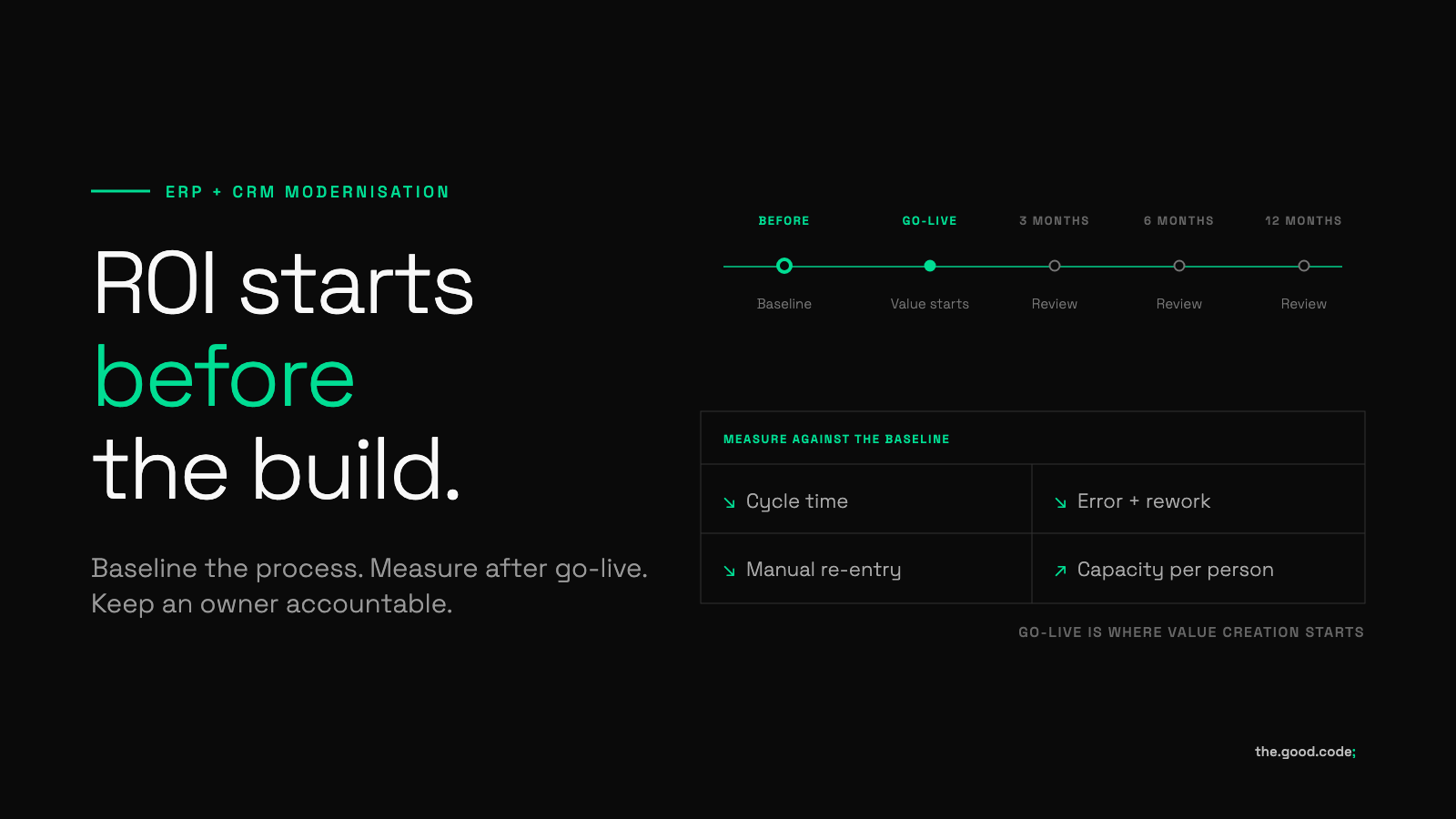
Capture your current-state numbers before anyone touches the system, because you cannot prove improvement without a starting point.
- Cycle time for your core process, end to end. Order to cash, request to resolution — whatever runs your business.
- Error and rework rate. How often work has to be redone, and what each rework event costs.
- Manual re-entry hours. Time spent copying data between systems that do not talk to each other. Pure waste, easy to measure.
- Headcount per unit of volume. How many people it takes to process a given number of orders. The ratio that improves here is where durable ROI lives.
Build this into a simple model before the project starts: cost category, benefit category, and a confidence level on each benefit. Model benefits conservatively. If you expect to cut a cycle by 80 percent, put 50 percent in the model and treat the rest as upside. If the hard numbers alone justify the work, the softer benefits become a bonus rather than a crutch.
The metrics that actually prove value
Track operational metrics, not technical ones. Logins and uptime are necessary, and they prove nothing about business value. Four metrics carry a modernisation's return:
- Core cycle time — direct revenue and cash impact. Honest benchmark: a 30 to 60 percent reduction on a well-scoped process.
- Error / rework rate — every rework has a cost and a trust cost. Honest benchmark: a meaningful drop within two quarters.
- Manual re-entry hours — pure waste, easy to measure. Honest benchmark: often the fastest visible win.
- Headcount per volume unit — compounding leverage as you grow. Honest benchmark: carries the multi-year ROI.
Ranges vary widely by business, scope, and how well the work is run, so treat any published ROI percentage as a reference point, not a promise. The cost of the status quo is easier to pin down. McKinsey puts technical debt at 20 to 40 percent of the value of a company's entire technology estate, with 10 to 20 percent of the budget meant for new products diverted to servicing it, and finds that teams which manage it actively free up as much as 50 percent more engineering time for work that moves the business [2]. That freed capacity is often the largest single line in a modernisation's return.
Where the return is really won or lost: after go-live
Most software ROI dies after go-live, not during the build, and the cause is structural rather than technical.
Take a mid-sized industrial business running a fifteen-year-old ERP with three bolt-on tools around it. The modernisation goes live on time. The project team hands over and leaves. Within a year adoption has drifted, workarounds have crept back, and the old manual process is running quietly alongside the new system. The ROI case was real. Nobody owned it after launch, so it evaporated.
Go-live is where value creation starts, not where the project ends. The implementations that hold their return are the ones where someone senior stays accountable for the system afterwards. Not a support ticket queue. An owner who reviews the metrics against the baseline at 3, 6 and 12 months and acts when they drift.
This is the part most vendors leave out of the quote, because it is the part that costs them margin. We price it in, because it is the part that decides whether you get your money back.
Why AI-native systems change the return curve
AI-native systems grow their value after go-live instead of holding it flat, which changes how you should model the return.
Conventional software is worth about the same two years after launch as the day after. It holds value, it does not grow it. A workflow with anomaly detection catches more errors as it learns what normal looks like. A system that assists a human decision gets more useful as it sees more decisions. So the return is not a flat annual line, it is a curve that bends upward. When you model ROI for an AI-native system, model year one, year two and year three separately, because they are genuinely different. The foundation matters more than the model here. Gartner expects organisations to abandon around 60 percent of AI projects that lack AI-ready data, and reports that 63 percent either do not have the data-management practices for AI or are unsure whether they do [3]. An AI-native system earns its compounding return only when the data and workflow underneath it are sound — one more reason to modernise the foundation before bolting AI on top.
This is also why modernising incrementally beats ripping everything out. You do not need to replace a working ERP to get here. Platforms like Open Mercato take this approach directly. It is MIT-licensed, with no licence fees and no vendor lock-in, and ships roughly 80 percent of the standard business-application scaffolding — authentication, roles, multi-tenancy, catalogue and orders — so a team builds only the 20 percent that differentiates the business. Open Mercato cites a logistics ERP built in six weeks on that model [4]. You add AI-native workflow and integration where the pain actually is, prove the return on one process, then extend. Smaller risk, sooner payback.
A note on speed, because we get asked. A measurable return in the first month is realistic, but it means the first measurable signal — an error rate moving or a cycle shortening — not full payback. Full payback on a modernisation is usually a matter of quarters. Anyone promising complete payback in thirty days is selling, not delivering.
FAQ
What is a good ROI for an ERP or CRM modernisation?
A well-run modernisation typically returns into the triple digits over three to five years. The more useful question is whether the ROI was measured against your own baseline rather than a vendor benchmark. Projects grounded in real current-state data and owned after go-live consistently beat projects that treat ROI as a one-time justification.
Can you calculate the ROI before the project starts?
Yes, and you should. A pre-project model built on your baseline numbers, conservative benefit assumptions and full TCO is the most valuable planning tool a leader has. Treat it as a living document, updated at each milestone, not a one-off approval slide.
Do we have to replace our whole ERP to modernise?
No, and usually you should not. The lower-risk path is to modernise the process that hurts most, prove the return, and extend from there. AI-native platforms are designed to work alongside existing systems rather than force a full rip-and-replace.
Sources
- Harvard Business School Online, "How to Calculate ROI to Justify a Project," 2024.
- McKinsey & Company, "Tech debt: Reclaiming tech equity," 2020.
- Gartner, "Lack of AI-Ready Data Puts AI Projects at Risk," February 2025.
- Open Mercato, "Open Mercato FAQ" (dev.to/tkarwatka) and openmercato.com — vendor's own claims.