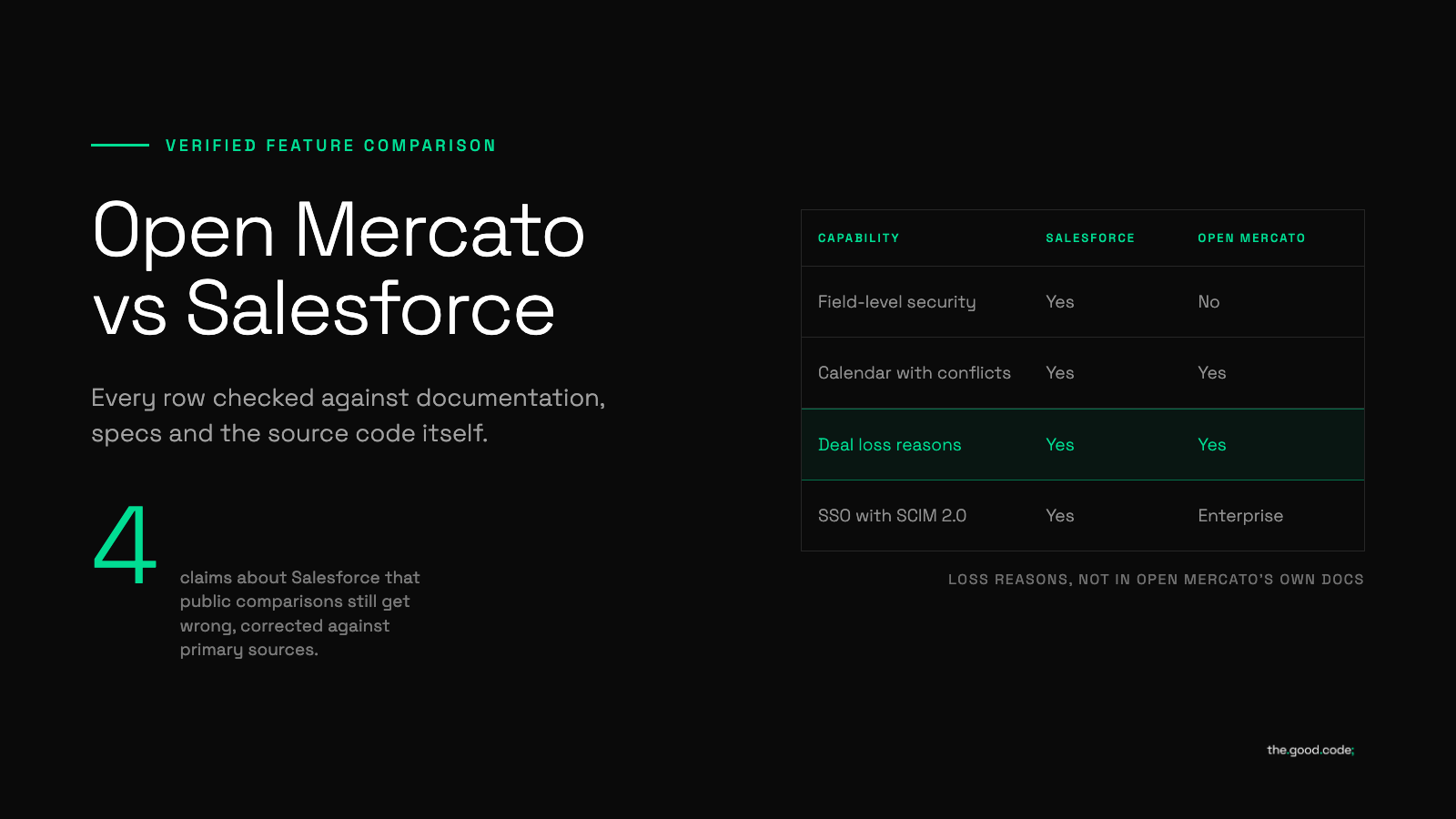
Comparisons of Open Mercato and Salesforce Sales Cloud are usually written from feature grids, and that is how they end up wrong within a quarter. Every claim below comes from a document you can open: Open Mercato's own documentation, release notes, specifications and published QA scenarios on one side, and Salesforce's documentation and public price list on the other. Where a source contradicts a claim that circulates about either platform, including one that would flatter us, we say so.
We build custom software for manufacturers and operations-led companies, and we are a certified Open Mercato implementation partner. That is where every fact below comes from, and it is also the reason to check our columns as carefully as anyone else's.
The short verdict
- Delivery model — Salesforce: closed SaaS, per-user licensing. Open Mercato: MIT-licensed core, self-hosted or cloud, no per-seat licence; optional paid Enterprise Edition subscription for certification, security review and support.
- Extensibility — Salesforce: Apex, Flow, AgentExchange (renamed from AppExchange in April 2026). Open Mercato: TypeScript modules with overlays, no-code custom entities and fields, open REST APIs.
- AI — Salesforce: Agentforce, bundled into current Sales editions. Open Mercato: built-in agents under the same RBAC as users, model provider of your choice, human approval before writes.
- Commerce inside the CRM — Salesforce: quotes and orders from Professional; full quote-to-cash needs Revenue Cloud Advanced. Open Mercato: quotes, orders, invoices, credit memos, payments and taxes included.
- Analytics — Salesforce: self-service report builder, Collaborative Forecasts. Open Mercato: dashboards, saved views, export on every endpoint. Report building and forecast rollups are absent.
- Access control — Salesforce: sharing rules and field-level security. Open Mercato: role, feature and organisation scoping, plus per-tenant field-level encryption.
- Data ownership — Salesforce: vendor-hosted. Open Mercato: your database, your infrastructure if you want it.
Two sentences summarise the whole comparison. Salesforce is ahead at the top of the funnel and in analytics and access governance. Open Mercato is ahead in the operational middle, from quote to paid invoice, and in what you own.
Feature by feature
The rows below come from Open Mercato's user-guide documentation where it exists, and from the repository (entity definitions, specs, component code) where the documentation has not caught up with the product yet. That second category is common: several of the entries below, including the deal pipeline fields and the full calendar module, do not appear in Open Mercato's own docs at all. We checked the code because the marketing page and the docs both undercount what has already shipped.
Accounts and contacts
- Companies and people — Salesforce: Accounts and Contacts. Open Mercato: Companies and People.
- Person-to-company relationships — Salesforce: one primary account per contact, multi-account needs a separate feature. Open Mercato: many-to-many by design, with a role recorded at each company.
- Addresses — Salesforce: standard billing and shipping fields. Open Mercato: multiple addresses per record, with latitude and longitude stored on each one.
- Standalone individual customers — Salesforce: Person Accounts, must be enabled. Open Mercato: native, a person can be a customer without a company record.
The relationship graph is more flexible than Salesforce's default, which matters for B2B teams selling into buying committees that span several companies. The stored coordinates are the data layer a map view would need; see the caveat on deal maps below.
Leads and pipeline
- Dedicated Lead object — Salesforce: yes. Open Mercato: no, a single record carries a lifecycle stage, temperature and source from first touch to closed customer.
- Multiple pipelines — Salesforce: needs record types and configuration. Open Mercato: included, each with its own reorderable stages.
- Kanban board — Salesforce: basic kanban view. Open Mercato: drag-and-drop board with per-stage totals and an undo prompt after every move.
- Stalled-deal flagging — Salesforce: via reports. Open Mercato: a configurable stuck-and-overdue threshold (14 days by default) marks a deal on the board; the alert is a visual badge today, not yet a push notification.
- Loss reasons and closure notes — Salesforce: yes. Open Mercato: structured loss-reason and closure-outcome fields on the deal record.
- Stage history — Salesforce: field history tracking. Open Mercato: a dedicated stage-transition log per deal.
- Map view of deals — Salesforce: no (AgentExchange, see below). Open Mercato: address coordinates are stored, but the map tab in the deals workspace is built and hidden pending release, not shipped yet.
High-volume inbound teams that run lead queues and report on conversion have to redefine those metrics against lifecycle stages before migrating; there is no Lead object or conversion step to map onto. The rest of this list understates Open Mercato in most public comparisons, including the one this article started from, because loss reasons, the stage log and the stuck-deal threshold live in the codebase and are absent from the published docs.
Activities and calendar
- Timeline of calls, emails, meetings, notes, tasks — Salesforce: yes. Open Mercato: yes, on every contact, company and deal.
- Calendar — Salesforce: basic calendar. Open Mercato: a dedicated calendar module with month, time-grid and agenda views.
- Recurring events — Salesforce: yes. Open Mercato: yes.
- Participants and conflict detection — Salesforce: yes. Open Mercato: yes, conflicting events are flagged on the agenda.
- Event locations — Salesforce: standard fields. Open Mercato: typed as a URL, a venue or a platform.
This calendar module is not mentioned in Open Mercato's own user-guide documentation. We found it by reading the component code rather than the docs, which is the same gap that hid the deal-pipeline fields above.
- Any mailbox via IMAP or SMTP — Salesforce: Outlook connector only. Open Mercato: yes, any provider.
- Contact matching — Salesforce: yes. Open Mercato: yes, inbound email links to the right customer automatically.
- Assigning a thread to a colleague — Salesforce: requires Service Cloud or add-ons. Open Mercato: built in, a personal mailbox can explicitly hand a thread to another user.
- Marketing-style templates and list sends — Salesforce: yes. Open Mercato: not included, transactional email only.
- AI reading forwarded mail — Salesforce: Einstein classification. Open Mercato: a separate shared inbox agent extracts orders, quotes and contacts from forwarded threads for one-click approval (see AI assistant, below).
The gap is outbound marketing email: templates, merge fields, list sends. If you run Salesforce list email today, budget for a dedicated marketing tool alongside Open Mercato.
Quotes, orders and billing
- Quotes — Salesforce: basic; full capability needs the paid CPQ add-on, discontinued for new customers since 27 March 2025. Open Mercato: included, with configured order numbering on conversion.
- Quote to order to invoice — Salesforce: needs CPQ plus Billing. Open Mercato: one continuous flow, with comments, addresses, shipments, payments and adjustments as tabs on the order.
- Credit memos and payment allocation — Salesforce: Salesforce Billing or partners. Open Mercato: included, confirmed in the published QA scenarios.
- Tax handling — Salesforce: via partners such as Avalara. Open Mercato: built in, rates scoped per tenant, organisation, country, region, channel and customer group, four-decimal precision.
- Multi-currency — Salesforce: yes, advanced setup. Open Mercato: ISO 4217 currencies with rates entered manually or fetched automatically from configured providers.
If your team exports opportunities into a separate quoting or ERP tool today, this is the seam Open Mercato closes: quote, acceptance, order, invoice and payment in one audit trail. In Salesforce, the equivalent span needs Revenue Cloud Advanced now that CPQ is discontinued for new customers.
Automation and workflows
- Visual workflow builder — Salesforce: Flow. Open Mercato: a visual editor with human approval steps, sub-workflows and waits for external signals with timeouts.
- Error handling — Salesforce: manual. Open Mercato: automatic rollback of partially completed processes (the saga pattern, documented as "Compensation").
- Parallel branches — Salesforce: yes. Open Mercato: not in the documented step types; a workflow can call a sub-workflow but cannot fork into parallel paths.
- Validation and calculation rules — Salesforce: yes. Open Mercato: a dedicated rules engine (validation, calculation, assignment, transition guards) with execution logs.
Reporting, dashboards and customisation
- Dashboards — Salesforce: yes. Open Mercato: role-assignable widgets, a layout API, saved views.
- Ad-hoc report builder — Salesforce: yes, a core strength. Open Mercato: not yet; new report types are configured by an implementation team rather than built by end users.
- Forecasting and quotas — Salesforce: Collaborative Forecasts. Open Mercato: deal value, probability and close dates exist; there is no rollup or quota module.
- Custom fields and entities — Salesforce: yes. Open Mercato: yes, from the admin UI, no code.
- Field history and undo — Salesforce: field history tracking. Open Mercato: a full audit log with undo, currently covering directory tenants and organisations, auth users and roles, and example todos; other modules opt in as they add it.
If sales leadership runs on Salesforce forecast submissions and custom matrix reports, that is the sharpest functional gap here, usually closed with a BI tool over your own database rather than a CRM feature.
AI assistant
- Ask questions in natural language — Salesforce: yes. Open Mercato: yes, scoped to whatever the asking user can already see.
- AI takes actions — Salesforce: Agentforce. Open Mercato: only after explicit human confirmation, staged as a proposal card with a field-level diff.
- Declared safety modes — Salesforce: not documented as tiers. Open Mercato: three, read-only, confirm-required and destructive-confirm-required; an admin can tighten a mode, never loosen it past what the agent declares.
- Choice of AI model — Salesforce: Salesforce-managed. Open Mercato: Anthropic, OpenAI, Google or a self-hosted model, configurable per tenant.
- Reads forwarded email — Salesforce: Einstein classification. Open Mercato: a dedicated inbox agent extracts orders, quotes, shipments and contacts from a forwarded thread and proposes them for approval.
Proposals expire after fifteen minutes of inactivity. The stuck-deal flag above is a rule-based threshold on days-in-stage, run without AI involvement, despite how that feature sometimes gets described as a "deal health scoring" agent.
Customer portal
- Customer portal — Salesforce: Experience Cloud, licensed separately. Open Mercato: included.
- Company accounts with sub-users — Salesforce: yes. Open Mercato: yes, customer admins manage their own colleagues.
- Own domain — Salesforce: yes. Open Mercato: yes, with automatic certificates.
Security, compliance and administration
- Role-based permissions — Salesforce: profiles and permission sets. Open Mercato: roles with feature-level permissions and per-user overrides.
- Field-level security — Salesforce: yes. Open Mercato: not at the field level; access is controlled at the feature and organisation level.
- Per-record sharing — Salesforce: yes. Open Mercato: no dedicated sharing engine; access is scoped by organisation.
- Data encryption — Salesforce: Shield, a paid add-on. Open Mercato: field-level encryption, tenant-scoped keys, included in the core.
- Single sign-on — Salesforce: yes. Open Mercato: Enterprise Edition, OIDC login and SCIM 2.0 provisioning, tested against Entra ID, Zitadel and Google Workspace.
- MFA and step-up authentication — Salesforce: yes. Open Mercato: Enterprise Edition, multi-factor authentication and sudo re-authentication for sensitive actions.
- Concurrent-edit protection — Salesforce: last-write handling. Open Mercato: Enterprise Edition, optimistic or pessimistic record locking, live editor presence, and a conflict-resolution dialog.
Field-level security and per-record sharing are the row that disqualifies some migrations outright: role and organisation scoping will not hide a single field from a colleague who can open the record. Per-tenant encryption is a different control for a different threat, protecting data from whoever reaches the storage rather than from a colleague inside it.
Integrations and data migration
- APIs — Salesforce: REST and SOAP. Open Mercato: open REST with OpenAPI documentation, plus native MCP for AI tools.
- Webhooks — Salesforce: outbound messages, platform events. Open Mercato: signed webhooks with retries and delivery logs.
- Export — Salesforce: Data Loader. Open Mercato: a format parameter (csv, json, xml or markdown) on any list endpoint.
- Bulk import or migration tooling — Salesforce: Data Loader. Open Mercato: none documented; moving Salesforce Accounts, Contacts and Opportunities into companies, people and deals is scoped as implementation work, not a self-serve import.
- App marketplace — Salesforce: AgentExchange (formerly AppExchange), thousands of apps. Open Mercato: a growing set of official modules; one published today.
Export tooling exists on both platforms. Mapping custom fields, deduplicating records and reconciling history is implementation work on both sides, whatever a feature grid implies about either one.
Four claims about Salesforce that the sources contradict
- Quoting. Comparisons still tell buyers to budget for the paid Salesforce CPQ add-on. A new customer cannot buy Salesforce CPQ after 27 March 2025 and is routed to Revenue Cloud Advanced instead.
- Map view of deals. Often listed as unavailable in Salesforce. Salesforce Maps costs $75 per user per month, with an advanced tier at $150, on Salesforce's own add-on price list. The honest argument is price, not availability, and it cuts both ways: Open Mercato's own map view is not shipped yet either, as the list above shows.
- Email activity capture. Presented as a Salesforce add-on. A standard tier of Einstein Activity Capture is included with Sales Cloud editions, capped at 100 users with three to six months of retention, with the full version behind higher editions or the add-on, per third-party pricing analysis.
- AI naming. Einstein Copilot no longer describes the current product. Salesforce now sells this under Agentforce, folded since October 2025 into the wider Agentforce 360 umbrella alongside Data 360 and Slack, and access is bundled into current Sales editions rather than sold purely as a tier.
Salesforce to Open Mercato concept map
- Account — Company
- Contact — Person, with many-to-many company relationships and a role at each
- Lead — Person or company with a lifecycle stage
- Opportunity — Deal, on one of several pipelines
- Task, Event — Activity, with a full calendar
- Quote (CPQ) — Quote, convertible to an order with configured numbering
- Order plus Billing — Order, invoice, credit memo, payment
- Price book — Price kinds with customer, group, channel and volume scoping
- Flow, approval process — Workflows and business rules with approval steps and execution logs
- Custom object, custom field — Custom entity, custom field, from the admin UI
- List view — Saved view
- Einstein, Agentforce — AI agents under your RBAC, model provider of your choice
- Experience Cloud portal — Customer portal, own domain
- Profiles, permission sets — Roles and feature permissions
The maturity question, before any of this matters
Do you require five years of production references from a platform vendor? If yes, Open Mercato is the wrong choice and we say so in the first call.
The project is young: a small core team, one paying enterprise deployment in production, one published official module in the ecosystem repository, and a public statement from its own team that it will not be stable in the five-years-of-references sense for another two years. Accounting is absent, so Polish statutory invoicing such as KSeF needs a connected system or a build. The catalogue and quoting module is early, so complex configure-to-order products with nested rules and CAD or BOM output get scoped as a build on the platform or routed to a mature configurator.
None of that appears in a feature table, and all of it decides whether a migration survives your board's diligence.
Where the trade-off lands
Salesforce's advantage matters when the dependency is analytics and governance: forecast submissions inside the CRM, self-service reports, field-level visibility rules, high-volume lead queues, campaign attribution. None of that is a gap Open Mercato closes today.
Open Mercato's advantage matters when the dependency is the process itself: quotes leaving the CRM for another tool, someone re-typing orders into an ERP, payment status living in a fourth system, licence maths deciding who gets to see a customer. That advantage assumes a technical partner in the picture, in-house or hired, since the platform ships as code, not a finished product.
Mapping which of these dependencies you have takes less time than either column suggests. The method is in how to map your software ecosystem before any integration project, and the exercise takes an afternoon. If you want a second pair of eyes on it, book a welcome coffee and we will go through this comparison against your own setup, including the rows where we would tell you to stay where you are.
Frequently Asked Questions
Is Open Mercato a real alternative to Salesforce today?
For pipeline execution and customer operations, yes, and the documentation and published test scenarios let you verify that before a demo. For CRM-native forecasting, self-service reporting and field-level access control, no. The honest framing is a swap of analytics and governance depth for process coverage and ownership.
What does Open Mercato cost compared with Salesforce?
The core is MIT licensed with no per-seat fee, and an enterprise subscription covers audits, security review and priority support. The comparison that matters includes implementation, the BI layer replacing the report builder, a marketing tool for list email, integrations replacing AgentExchange installs, and the team maintaining the platform. A comparison that only counts licences is how migrations end up over budget.
Can Open Mercato handle quotes for configurable products?
It has a catalogue and quoting module, and it is early. For products with nested configuration rules, 3D or CAD and BOM output, we either extend that module as part of the engagement or recommend a mature configurator and integrate it. We say which one in discovery rather than after the contract.
Who implements Open Mercato in Europe?
Several partners, and we are one of them. The differentiator worth asking any of us about is contribution to the core and delivery experience in your industry, rather than partner status on a page.
Sources
- Salesforce, Salesforce CPQ end of sale, 27 March 2025 (vendor primary)
- Salesforce, Salesforce Maps pricing and add-on price list (vendor primary)
- Salesforce and IDC, Salesforce Economy study (vendor-commissioned)
- RevenueGrid, Einstein Activity Capture pricing in 2026 (third-party analysis)
- Open Mercato, release notes 0.6.x, 0.6.6 published 17 July 2026 (project primary)
- Open Mercato, 10 IT Department Fears About Open Mercato (project primary, source for the maturity figures below)
- Open Mercato, orders and quotes guide, taxes, currencies and exchange rates, export contract, dashboards API, integrations and data sync (project primary)
- Open Mercato, SPEC-037 InboxOps agent (project primary)
- Open Mercato, Enterprise Edition overview, record locks, Single Sign-On (project primary)
- Open Mercato, workflow step types, workflow engine overview, deals workspace (project primary)
- Open Mercato, deals kanban redesign spec, customer entity definitions, calendar component types (project primary, repository rather than published docs)