We built a senior-care operations system in a hackathon, because 97% of its foundation already existed
Status: a demo build from the Open Mercato Hackathon in Sopot, 2026, with no production deployment behind it
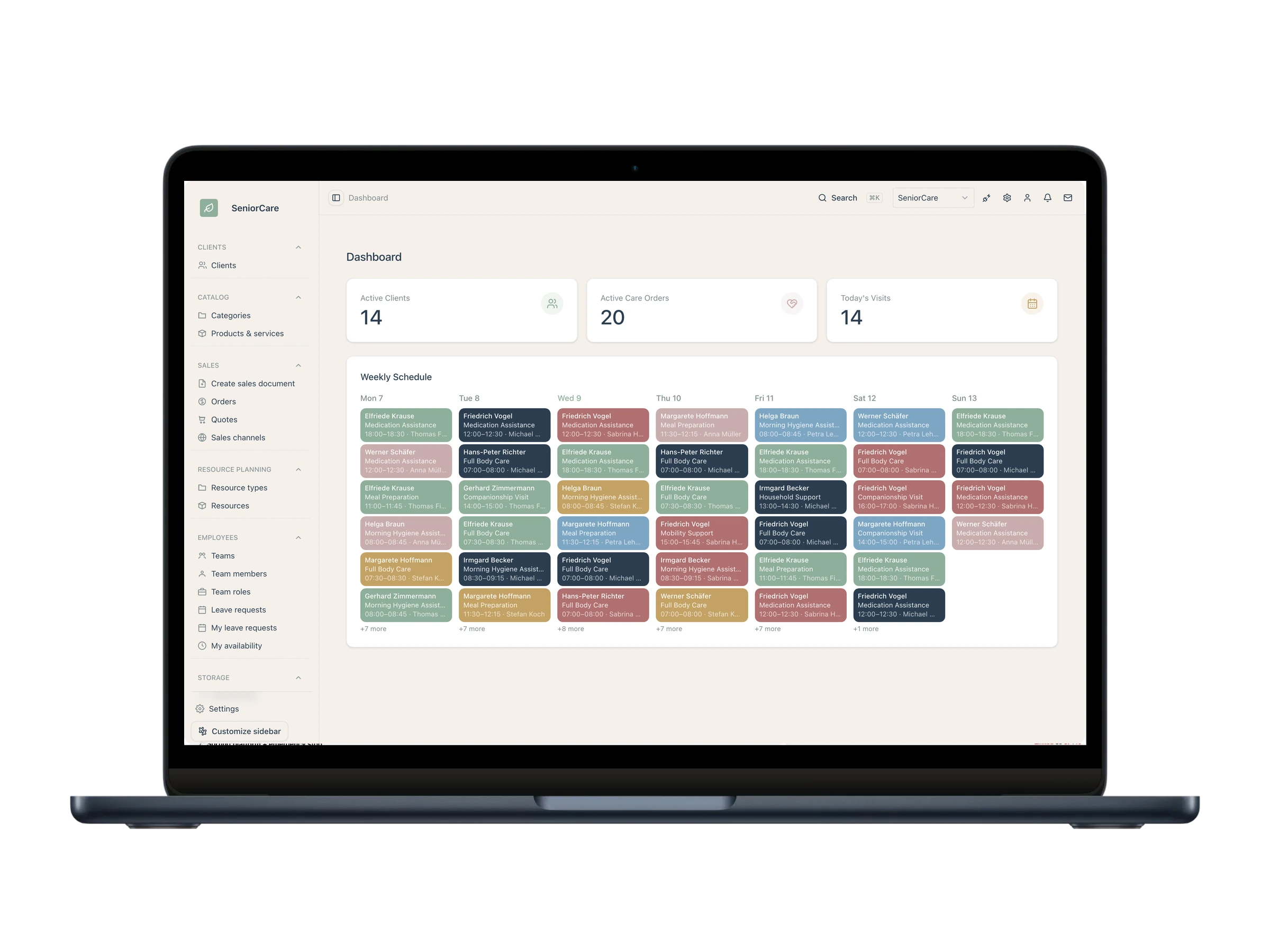
This page describes a demo built during the Open Mercato Hackathon in Sopot, 2026. It is not a production deployment and it has no client outcomes attached to it.
Senior Care Operations is a vertical operations system for German non-medical senior care providers. It covers client records, teams and caregivers, care orders, weekly schedules, and signed service confirmations, from one back office.
The point of the build was the ratio. Roughly 97% of the product foundation came from reusable Open Mercato core, and around 3% was custom senior-care logic. That is what let a small team spend its hours on care workflows such as shift validation and signature capture, instead of on authentication, the data layer, and the back office.
What the build gives is a proportion measured on real work, and a reference architecture for anyone weighing a vertical operations product against a rigid off-the-shelf system.
Business challenge
German senior care operators run a hard coordination problem: large distributed teams, a high share of part-time caregivers, thousands of clients, and several regional branches, all scheduled week by week.
The regulatory layer sits on top. When services are financed through Krankenkasse processes, delivered care has to end in a confirmation that can be checked later. A visit that happened but cannot be evidenced becomes a billing loss.
Operators typically reach for one of two options, and both cost them:
- →spreadsheets hold up until the first week that changes shape, then stop being a record of what happened
- →commercial vertical systems solve the coordination and arrive with licence costs, a total cost of ownership that grows with headcount, and interfaces that resist the operator’s own process
In the second case the provider ends up adapting its care model to the software.
Solution overview
We built a single operational surface on Open Mercato, then added only what senior care needs on top.
Open Mercato supplied the AI-Engineering Foundation Framework: authentication, the back-office UI structure and navigation, the data layer, events, search, and scheduling primitives. Client records, teams, team members, roles, attachments, currencies, and settings are platform building blocks, so they cost close to nothing to stand up.
Our senior-care layer covers care orders, the manager dashboard, weekly schedule periods, service-confirmation states, shift validation, and signed confirmation workflows. Each of those encodes a rule that only exists in regulated home care.
Key elements of the solution
Care orders as the unit of commitment
- →a care order links a client to a service type: mobility support, full body care, medication assistance, morning hygiene assistance, or a companionship visit
- →it carries status, frequency, duration, and quantity, which turns an agreement with a family into a scheduled obligation the system can plan against and later evidence
Weekly schedules per branch, with a publication state
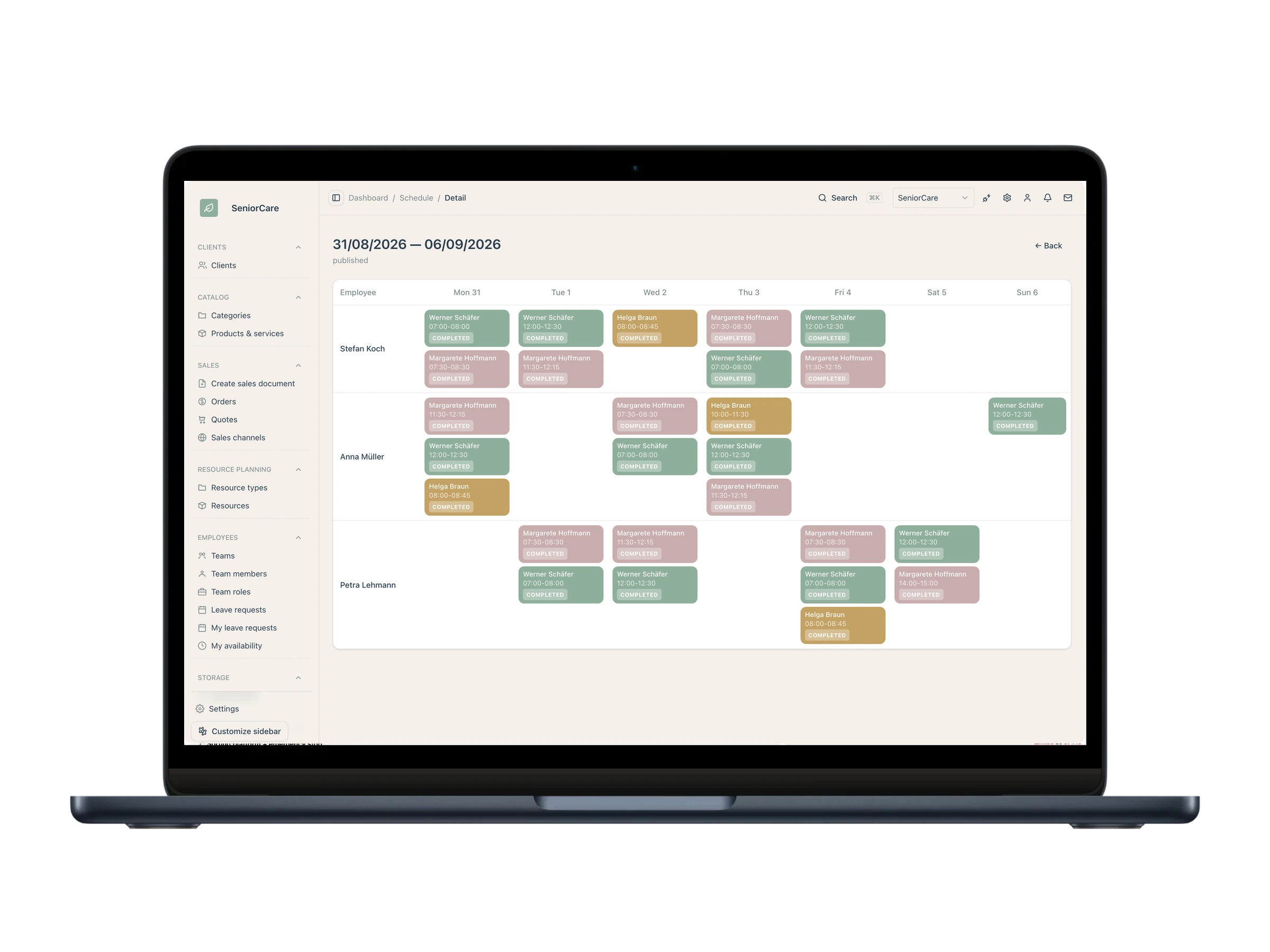
- →managers create weekly schedule periods per branch, each with its own status, start and end dates, publication state, and notes
- →inside a period a manager adds a visit by selecting the client and caregiver, setting the date and time, and attaching notes
- →publication state answers the question a spreadsheet answers worst: what is planned, and what still needs attention
Service confirmations move through five states
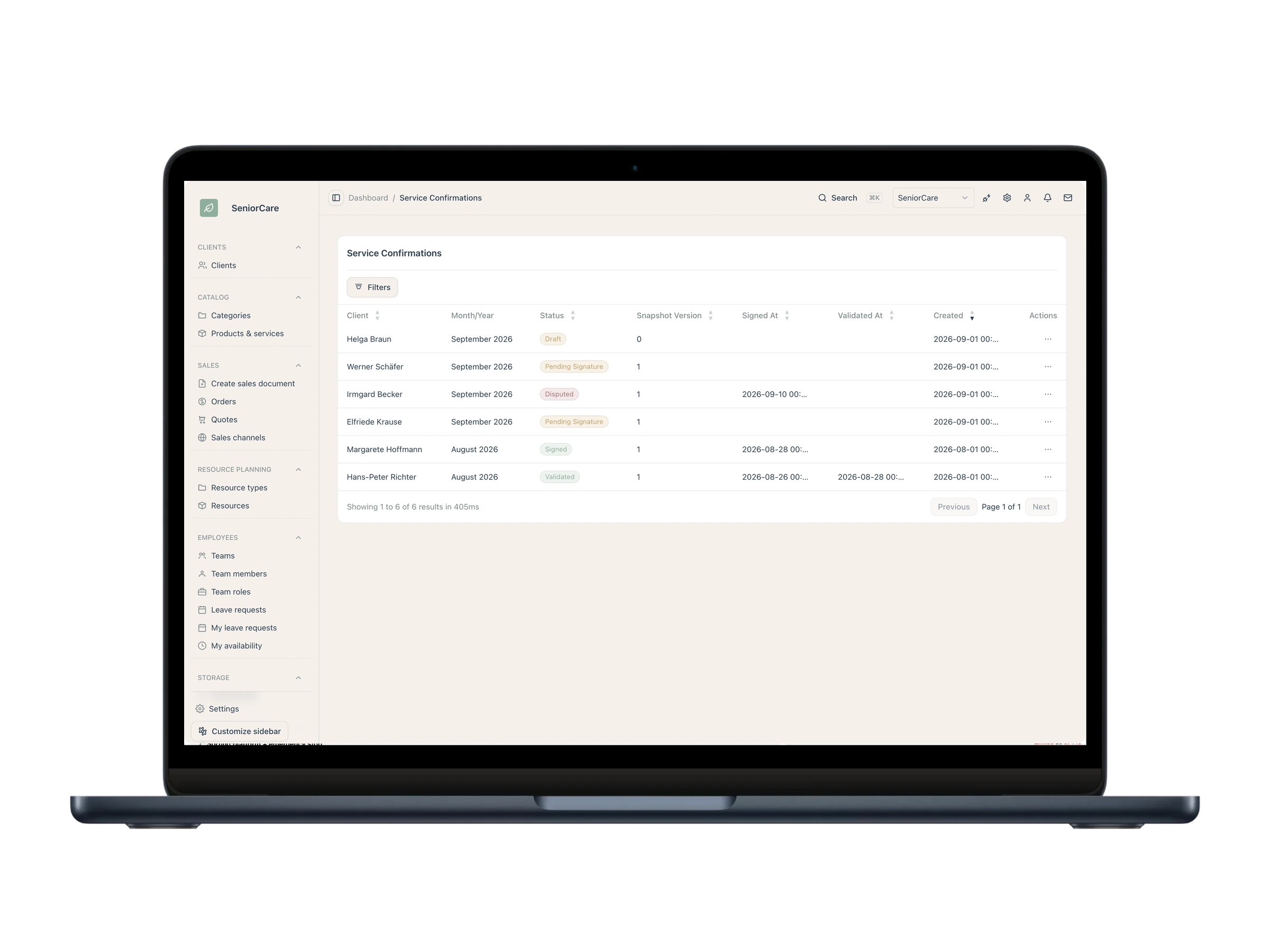
- →delivered care moves through draft, pending signature, signed, disputed, and validated
- →the system groups monthly service lines, calculates totals, and stores frozen snapshots, so a confirmation stays readable months later even after the underlying schedule changes
- →the disputed state carries weight here, because a disagreement about a visit becomes a tracked state instead of an email thread
Signature capture where the care happens
- →the client signs directly on screen, and the manager validates the confirmation once it matches the delivered visits
- →that two-step split, signature at the point of care and validation against the schedule, is what makes the record hold up in a Krankenkasse-financed process
What the build demonstrates
This section reports what we measured on the hackathon build. It is a demo, so it contains no production metrics and no client outcomes.
- →roughly 97% of the product foundation was reusable: authentication, the data layer, events, search, scheduling primitives, and the back office came from Open Mercato core rather than from our sprint
- →around 3% was custom senior-care logic: care orders, the confirmation state machine, shift validation, and signed workflows
- →the whole vertical flow was standing at the end of the build, from login through scheduling to a signed and validated confirmation
- →the operator owns the result: Open Mercato is open source, so the foundation carries no licence fee and no vendor controls the exit
Strategic impact
For a care operator this decides where the engineering budget goes. When the platform layer is already solved, the spend moves to the part that differentiates one provider from another: how shifts are validated, how disputes are handled, how a confirmation is evidenced. That work compounds, while rebuilding authentication does not.
For anyone assessing Open Mercato, the 97/3 proportion is a data point from one vertical, measured on one build, under hackathon conditions. It shows the foundation carrying a regulated operations domain further than a generic framework would. The same ratio in a different domain remains an open question, and we treat it as one.
We are a certified Open Mercato agency and a contributor to the core. This build is how we test what the platform holds before a client’s budget depends on the answer.
The build is also documented by Open Mercato: see the case study on openmercato.com, our certified partner profile, and the walkthrough recording.
work.with.us;
Bring one real problem; leave with a clear answer.